
What is pure water?
Ordinary tap water carries dissolved minerals such as calcium and magnesium, plus a little salt. You can't see them, but they're there. Our purification unit runs the water through filters and then a de-ionising resin, which pulls those minerals out. What comes out the other end is water with almost nothing dissolved in it.
Why does tap water leave spots on windows?
When a drop of tap water dries on glass, the water evaporates and the minerals stay behind. That's the white ring you see after rain, or after the sprinkler catches a window. Clean a window with tap water and you leave the same minerals behind.
Every town's water is different. Whangamatā and Hahei are some of the highest in the Coromandel for dissolved minerals: our TDS meter records over 200 parts per million there, and anything over about 20 starts leaving spots and marks on glass.
How does pure water clean the glass?
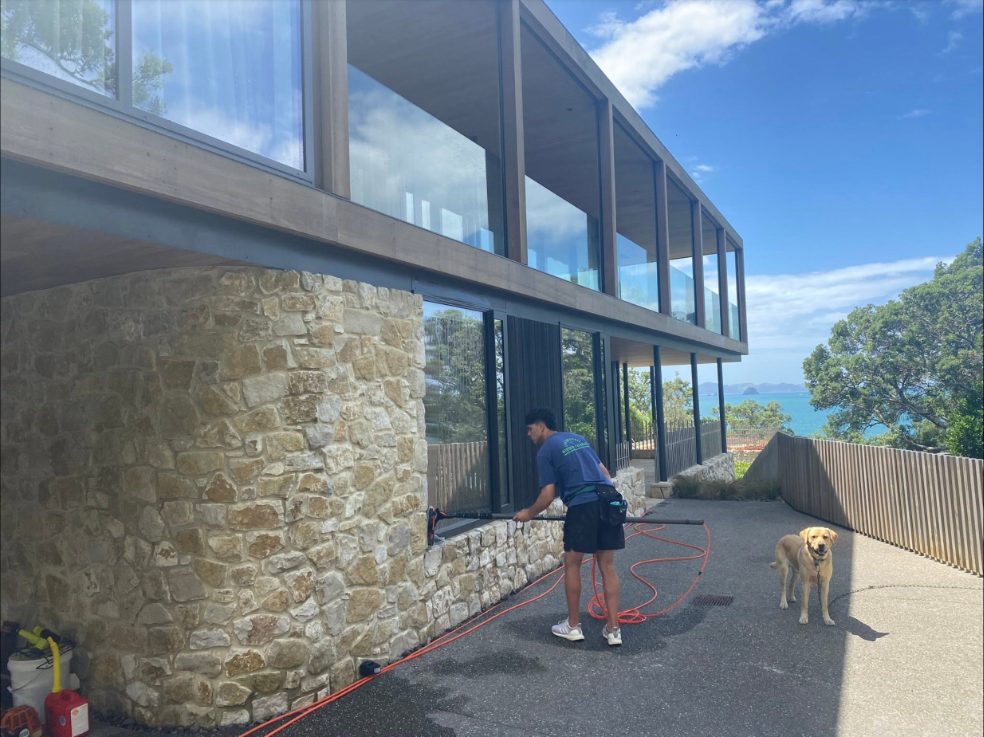
Because pure water has nothing in it, it readily takes up whatever it touches. We scrub the glass and frames with a soft brush on a water-fed pole, which loosens the dirt, salt and bird mess. A rinse of pure water carries it all away, and then the glass is left to dry on its own.
Our system also has a detergent dispenser, which applies a small amount of specialist detergent made for this machine and this application. It rinses off with the pure water. There's no squeegee on the outside glass, and with nothing in the rinse water, there's nothing left behind to dry as a spot.

Why does it matter on the coast?
Most of the homes we look after are within sight of the sea, from Tairua and Pauanui to Whangamatā and Hahei, including plenty of baches and holiday rentals. Onshore wind coats the glass with a fine layer of salt. Wipe that with a cloth and a bucket and you mostly move it around.
Salt dissolves easily in pure water, so it rinses off rather than smearing, and the glass doesn't dry with a salty haze.
Is pure water safe for my frames, garden and pets?
Yes. The specialist detergent is made for this system, only a small amount is used, and it's rinsed away with pure water. The brush cleans the frames and sills as we go, which a squeegee-only clean usually skips.
Can you reach upstairs windows?
Usually from the ground. Our water-fed poles reach up to 10 metres, which means fewer ladders on your lawn and garden beds and less risk for the crew. Where a ladder is the safer option, we'll use one.
Do you use pure water inside the house?
Yes, just not through the pole. We put the pure water in a bucket and clean the inside of the glass by hand, the old-school traditional way. A deep clean of the joinery (tracks, sashes and frames) is available as an optional extra.
Do you clean solar panels with pure water?
Yes. Salt, dust and bird droppings on panels cut how much power they make, and panels are easy to forget about because they're out of sight on the roof. Pure water cleans them without leaving a mineral film behind, the same as it does on glass. More on solar panel cleaning.
How often should coastal windows be cleaned?
It depends how exposed the house is. Most of our clients book a clean before summer, and many book again after the winter storms or the spring pollen. A beachfront home facing the wind needs it more often than a sheltered one. Ask Jono and he'll tell you honestly what your place needs, and what it doesn't.
Pure water and tap water at a glance
Tap water and detergent
- Dries with mineral spots and streaks
- Hard water towns mark glass the fastest
- Smears salt spray and pollen around
- Frames and sills often skipped
Pure water
- Dries clear, with no spots
- Rinses off, leaving nothing on the glass
- Lifts salt spray and pollen off
- Frames and sills washed at the same time
See the difference on your own windows
We cover Thames to Matarangi and everywhere in between. Call or text Jono for a quote, or send us the details.